A school feasibility study in the GCC assesses whether a proposed private school is commercially, operationally, and legally viable before major capital is committed. It reviews market demand, catchment demographics, competitor schools, curriculum fit, site suitability, licensing requirements, financial projections, staffing needs, and investor risk.
For school owners, developers, and investors, this study provides an evidence-based roadmap for deciding whether to proceed, adjust the concept, change the location, or pause the project. In markets such as Saudi Arabia, the UAE, Bahrain, Kuwait, Qatar, and Oman, early feasibility work is essential because education projects involve high setup costs, strict regulation, and long enrollment ramp-up periods.
A professional school feasibility study GCC investors can rely on helps reduce uncertainty before land is purchased, financing is requested, or design work begins. It gives banks, operators, family offices, and education groups the structured data they need to make a confident investment decision.
What This Blog Covers
This blog explains:
- What a GCC school feasibility study includes
- Why investors need feasibility before committing capital
- How market demand and catchment analysis work
- What financial modeling should cover
- Which regulatory and licensing factors matter
- How site suitability affects school viability
- How D3 Consultants supports school investors
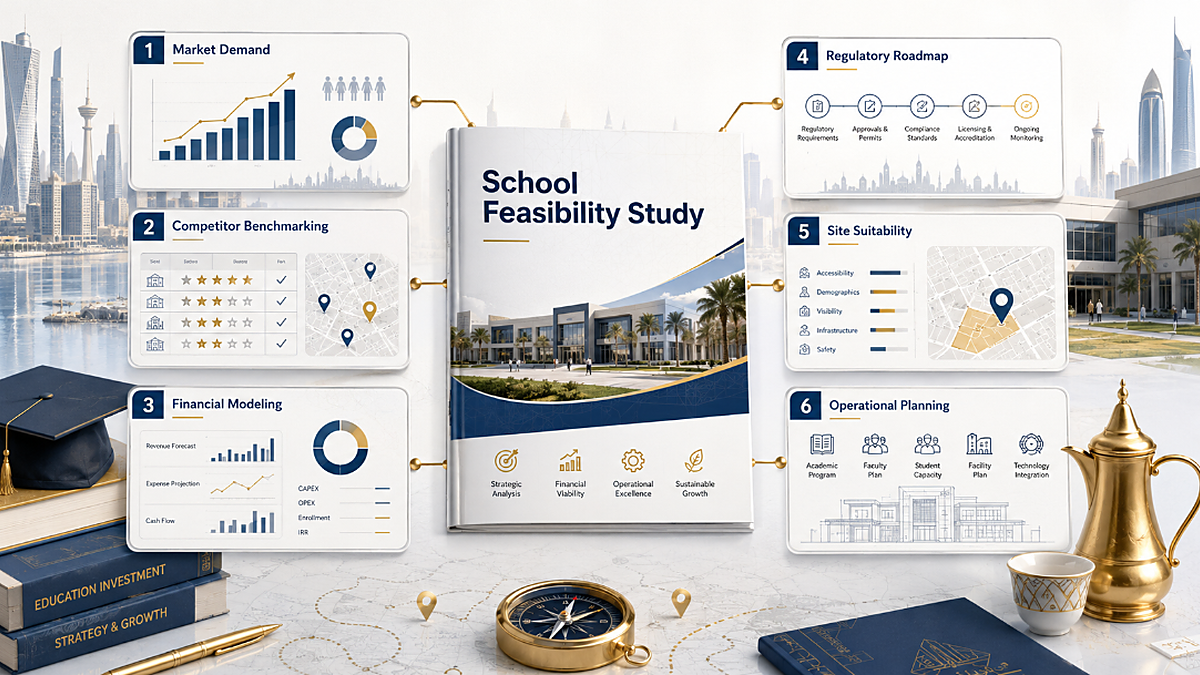
A GCC school feasibility study reviews demand, competition, financial viability, regulation, site suitability, and operations before investment.
What is Included in a GCC School Feasibility Study?
A GCC school feasibility study typically includes market demand analysis, competitor benchmarking, financial modeling, regulatory review, site assessment, operational planning, and risk testing. Together, these components help investors understand whether a proposed K-12 school, kindergarten, or specialist education project can attract enough students, meet local requirements, and achieve sustainable returns.
The goal is not only to confirm whether a school can be opened. The goal is to determine whether the school can operate successfully, reach enrollment targets, comply with regulations, and deliver the required return on investment over time.
At D3 Consultants, we support education investors, school owners, and operators across the GCC with feasibility studies, business planning, due diligence, and school development advisory. Our work helps transform an initial education concept into a clear, investment-ready plan.
Why School Investors in the GCC Need a Feasibility Study
Opening a private school in the GCC is a capital-intensive project. Investors must consider land acquisition, construction costs, licensing requirements, curriculum approvals, staffing, technology, pre-opening marketing, and working capital before the first students enroll.
Without localized research, investors may overestimate demand, choose the wrong curriculum, set unrealistic fees, or underestimate regulatory and operational costs. These errors can delay opening, increase funding pressure, and weaken long-term financial performance.
The GCC private education market continues to attract investor interest. According to Mordor Intelligence, the GCC private K-12 education market is expected to grow from USD 33.59 billion in 2025 to USD 37.56 billion in 2026, with further projected growth to USD 65.71 billion by 2031. This growth creates opportunity, but it also increases competition among schools, operators, developers, and education groups.
A school feasibility study helps investors answer critical questions before committing capital:
- Is there enough demand in the target location?
- Which curriculum has the strongest market fit?
- What fee level is realistic for the catchment area?
- How many students can the school attract?
- What site size and built-up area are required?
- What licensing approvals are needed?
- When will the school reach break-even?
- What are the main risks to the project?
These answers allow investors to make decisions based on evidence rather than assumptions.
1. Market Demand and Catchment Area Analysis
Market demand analysis is one of the most important parts of a private school feasibility study. It determines whether there are enough families in the target location to support the proposed school concept, curriculum, and fee structure.
This analysis usually examines the catchment area around the proposed site. The catchment area may include nearby residential communities, future housing developments, major employment zones, transport routes, and competing schools. The aim is to estimate how many school-age children live within a realistic travel distance of the proposed campus.
A strong market demand study reviews the following:
- Population size and growth
- School-age child demographics
- Household income levels
- Expatriate and local family segments
- Current private school enrollment
- Future residential development
- Parent preferences by curriculum
- Fee affordability by income group
- Travel patterns and accessibility
In the GCC, school demand can vary significantly from one area to another. A premium British curriculum school may perform well in one neighborhood, while an American, IB, Indian, or bilingual curriculum may be more suitable in another.
This is why localized research is essential. A city-level market report is not enough. Investors need a detailed view of the immediate catchment area and the specific family segments the school plans to serve.
2. Competitor and Curriculum Benchmarking
A school feasibility study must also assess the competitive landscape. This includes reviewing existing private schools, upcoming school developments, curriculum options, fee levels, capacity, facilities, reputation, and enrollment performance.
Competitor benchmarking helps investors identify where the market is crowded and where gaps still exist. It also helps determine how the proposed school should be positioned.
For example, the study may compare:
- British curriculum schools
- American curriculum schools
- IB schools
- Indian curriculum schools
- Bilingual schools
- Kindergartens and early years centers
- Special education providers
- Mid-market private schools
- Premium international schools
- Benchmarking should not only list competitors. It should explain what competitors offer, how they price their services, where they are located, and what type of families they attract.
- This helps investors answer important strategic questions:
- Is the market oversupplied?
- Are existing schools operating near capacity?
- Which fee segments are underserved?
- Which curriculum has the strongest demand?
- What facilities do parents expect?
- What differentiators will matter most?
- Can the proposed school compete effectively?
The findings shape the school’s market positioning, curriculum strategy, fee structure, facility planning, and launch marketing approach.
3. Financial Modeling and Unit Economics

Financial modeling helps school investors test enrollment, costs, revenue, break-even timing, and risk before committing capital.
Financial modeling is the part of the feasibility study that translates the school concept into numbers. It shows whether the proposed project can generate enough revenue to cover costs, repay investment, and create sustainable returns.
A detailed school financial model should include both capital expenditure and operating expenditure. It should also show the expected enrollment ramp, tuition revenue, staffing costs, fixed costs, working capital needs, and break-even timeline.
- A complete financial model usually includes:
- Capital expenditure
- Construction costs
- Fit-out and furniture
- Technology and equipment
- Pre-opening expenses
- Tuition fee assumptions
- Enrollment projections
- Staffing and payroll costs
- Rent or property costs
- Utilities and maintenance
- Marketing and admissions costs
- Working capital requirements
- Cash flow forecasts
- Profit and loss forecasts
- Break-even analysis
- Investor return scenarios
For school investors, unit economics are especially important. The study must show the cost per student, revenue per student, teacher-to-student ratios, class size assumptions, and the enrollment level required to operate profitably.
Sensitivity analysis should also be included. This tests how the project performs if assumptions change. For example, the model should show what happens if enrollment is 10% lower than expected, opening is delayed by one year, construction costs increase, or teacher salaries rise.
This level of detail helps investors understand the financial strength of the project before committing significant capital.
4. PropCo and OpCo Structure Review
Many GCC education investments involve a property company and an operating company structure. This is often called a PropCo and OpCo model.
The PropCo owns or develops the land and school building. The OpCo operates the school, manages staff, delivers education services, handles admissions, and runs day-to-day operations.
A feasibility study may review whether this structure is suitable for the project. It can help investors separate real estate returns from school operating returns and create a clearer structure for financing, leasing, partnerships, or future exit planning.
- The study may assess:
- Land ownership structure
- Lease assumptions
- Rental affordability
- Operator requirements
- Asset value potential
- School operating margins
- Investor return expectations
- Financing implications
- Long-term ownership strategy
This is especially useful when real estate developers, family offices, education operators, and institutional investors are involved in the same project.
5. Regulatory Roadmap and Ministry Approvals
Regulation is one of the most important factors in any GCC school feasibility study. Each country has its own licensing requirements, approval process, education authority standards, building regulations, and operational rules.
A school that appears financially attractive may still face delays if the site, design, curriculum, ownership structure, or operating model does not meet local requirements.
The regulatory review should cover:
- School licensing requirements
- Ministry of Education approvals
- Municipality requirements
- Civil defense requirements
- Building safety standards
- Curriculum approval pathways
- Ownership and investor requirements
- Teacher licensing rules
- Special education requirements
- Academic calendar requirements
- Inspection and quality standards
For example, setting up a school in Saudi Arabia may require alignment with Ministry of Education requirements, Saudization policies, building safety standards, and local labor regulations. In the UAE, requirements may vary by emirate and education authority. In Bahrain, Kuwait, Qatar, and Oman, investors must also consider country-specific licensing and operational standards. A feasibility study should identify these requirements early so the school concept, site plan, and business model can be designed around them.
6. Site Suitability and Built-Up Area Assessment
The proposed school site plays a major role in project viability. Even if market demand is strong, the site must be able to support the target student capacity, meet regulatory standards, and provide a safe and accessible environment.
A site suitability review examines whether the land or existing building can support the proposed school concept.
This includes reviewing:
- Plot size
- Built-up area
- Student capacity
- Classroom requirements
- Outdoor space
- Parking
- Drop-off and pick-up flow
- Bus access
- Traffic impact
- Safety requirements
- Accessibility
- Expansion potential
- Utilities and infrastructure
- Municipal restrictions
The study should also assess whether the site location matches the target parent audience. A premium international school, for example, needs convenient access from high-income residential communities. A mid-market school may need strong visibility, transport access, and competitive fees.
Site selection mistakes can be expensive. If the land is too small, poorly located, difficult to access, or unable to meet regulatory requirements, the project may need to be redesigned or abandoned. A feasibility study helps investors avoid purchasing or leasing a site that cannot support the school’s educational and financial goals.
7. Operational Strategy and Staffing Plan
A school feasibility study should also explain how the school will operate after opening. Many projects fail to account for the complexity of school operations during the first three years.
The operational strategy should cover the staffing model, leadership structure, recruitment timeline, academic planning, admissions process, marketing approach, and pre-opening activities.
A complete operational plan may include:
- Leadership hiring timeline
- Principal recruitment
- Academic team structure
- Teacher recruitment plan
- Administrative staffing
- Admissions team planning
- Marketing launch timeline
- IT and systems setup
- Policies and procedures
- Procurement planning
- School calendar
- Parent communication systems
- Quality assurance process
In GCC markets, staffing can be one of the largest operating costs. The feasibility study should account for salary benchmarks, benefits, housing allowances, visa costs, professional development, and teacher recruitment timelines.
In Saudi Arabia, the operating model must also consider Saudization requirements and local labor policies. Schools need to balance international educator recruitment with national employment expectations and compliance requirements. This operational planning helps investors understand what is required to move from construction to successful school opening.
8. Risk Assessment and Sensitivity Testing
Every school investment carries risk. A feasibility study should identify these risks and show how they can be reduced.
Common risks include:
- Overestimated enrollment
- Unrealistic fee assumptions
- Construction delays
- Licensing delays
- Higher-than-expected costs
- Staff recruitment challenges
- Weak parent demand
- Strong competitor response
- Regulatory changes
- Cash flow pressure
- Poor site selection
Sensitivity testing is especially useful because it shows how the financial model changes under different scenarios. For example, investors can see how the project performs if the school opens with fewer students than expected, if construction costs increase, or if tuition fees need to be reduced to compete.
This allows investors to prepare contingency plans before the project begins.
A strong risk assessment does not simply list problems. It provides practical mitigation strategies, such as phased development, adjusted capacity planning, revised fee positioning, improved pre-opening marketing, stronger operator selection, or a different site strategy.
9. What Investors Receive in the Final Feasibility Report
A professional school feasibility report should provide clear, decision-ready outputs. Investors should be able to use the report for board discussions, bank financing, partner negotiations, operator selection, and internal planning.
A typical report may include:
- Executive summary
- Market demand analysis
- Catchment area review
- Competitor benchmarking
- Curriculum recommendation
- Fee positioning
- Enrollment forecast
- Site suitability review
- Regulatory roadmap
- Capital expenditure estimate
- Operating cost forecast
- Financial model
- Break-even analysis
- Sensitivity analysis
- Risk assessment
- Implementation roadmap
- Investor recommendations
The final report should not be generic. It should be specific to the proposed location, school type, target audience, regulatory environment, and investor objective.
For example, a feasibility study for a premium K-12 school in Riyadh will differ from a kindergarten feasibility study in Bahrain or a mid-market school assessment in Oman. Each project requires its own assumptions, data, and strategy.
Pros and Cons of Commissioning a School Feasibility Study
A feasibility study is a valuable investment, but school owners and investors should understand both the benefits and the practical requirements.
Pros and Cons of a GCC School Feasibility Study
| Pros | Cons |
| Reduces capital risk before major investment | Requires upfront advisory cost |
| Validates market demand and location | Takes time to collect accurate data |
| Supports bank and investor discussions | Requires sharing project information |
| Identifies regulatory requirements early | May challenge initial assumptions |
| Improves enrollment and fee planning | Needs reliable local market research |
| Tests financial viability before launch | May show the project needs revision |
For serious school investors, the benefits usually outweigh the cost. A feasibility study can prevent expensive mistakes before construction, licensing, recruitment, and marketing begin.
Comparing the Main Components of a School Feasibility Study
The table below summarizes the main components of a GCC school feasibility study and the strategic value each one provides.
| Component | Main Focus | Strategic Output |
| Market Demand Analysis | Demographics and catchment area | Enrollment potential |
| Competitor Benchmarking | Existing schools and fee levels | Market positioning |
| Curriculum Review | Parent demand and school concept | Curriculum recommendation |
| Financial Modeling | Revenue, costs, and cash flow | Investment viability |
| Regulatory Review | Licensing and approvals | Compliance roadmap |
| Site Assessment | Land, access, and capacity | Site suitability decision |
| Operational Planning | Staffing and launch process | Pre-opening roadmap |
| Risk Assessment | Project risks and assumptions | Mitigation strategy |
Each component should work together. Strong demand is not enough if the site cannot support the target capacity. A strong financial model is not enough if the regulatory pathway is unclear. A good curriculum concept is not enough if parent demand does not support the fee level.
This is why a school feasibility study must be comprehensive, localized, and practical.
Post-Feasibility: Using the Study During the First Three Years
A feasibility study should not be used once and then forgotten. It should guide the school through pre-opening and the first three years of operation.
During this period, the school can compare actual performance against the original feasibility assumptions. This helps the leadership team monitor whether enrollment, staffing, revenue, costs, and parent demand are moving as expected.
Key performance indicators may include:
- Applications received
- Student enrollment
- Conversion rate
- Average fee level
- Student retention
- Staff-to-student ratio
- Marketing cost per enrollment
- Operating expenses
- Cash flow performance
- Break-even progress
If the school is underperforming against the original plan, the feasibility study can help identify where adjustments are needed. This may include changing the admissions strategy, revising the fee structure, adjusting staffing levels, improving parent communication, or strengthening the school’s market positioning.
For investors, this turns the feasibility study into an ongoing management tool rather than a one-time report.
How D3 Consultants Supports School Feasibility Studies in the GCC
D3 Consultants supports education investors, developers, school owners, and operators across the GCC with feasibility studies and education investment advisory.
Our work helps clients assess whether a proposed school project is viable before significant capital is committed. We combine market research, financial analysis, regulatory understanding, and operational planning to provide a clear view of project potential and risk.
D3 Consultants can support with:
- School feasibility studies
- Market demand analysis
- Competitor benchmarking
- Financial modeling
- Investment-grade business plans
- Regulatory roadmap planning
- Site suitability assessment
- School operator advisory
- Due diligence for acquisitions
- Pre-opening planning
- School improvement advisory
- Accreditation and quality support
Whether you are planning a new K-12 school, kindergarten, special education center, or education investment project, a feasibility study can help you make a more confident decision.
Common Questions About GCC School Feasibility Studies
What is a school feasibility study?
A school feasibility study is a structured analysis that determines whether a proposed school project is viable. It reviews market demand, competition, financial projections, licensing requirements, site suitability, staffing needs, and investor risk before major capital is committed.
What does a school feasibility study cover?
A school feasibility study usually covers market demand, catchment area demographics, competitor schools, curriculum options, fee positioning, financial modeling, regulatory requirements, site assessment, operating costs, staffing plans, and risk analysis.
Why is a feasibility study important before opening a school in the GCC?
A feasibility study is important because GCC school projects require significant investment and must meet strict regulatory requirements. The study helps investors avoid poor location choices, unrealistic enrollment assumptions, weak fee positioning, licensing delays, and unexpected operating costs.
Who needs a private school feasibility study?
A private school feasibility study is useful for education investors, school owners, real estate developers, family offices, school operators, and organizations planning to establish, acquire, or expand a school in the GCC.
How long does a school feasibility study take?
The timeline depends on the project scope, location, data availability, and level of analysis required. A detailed feasibility study usually requires time for market research, competitor review, financial modeling, regulatory review, and investor recommendations.
What are the five major components of a feasibility study?
The five major components are market analysis, financial analysis, regulatory review, operational planning, and site assessment. For school projects, these components are usually supported by competitor benchmarking, curriculum analysis, enrollment forecasting, and risk testing.
Can a feasibility study help secure financing?
Yes. A well-prepared school feasibility study can support financing discussions by giving banks, investors, and partners a clear view of market demand, financial projections, capital requirements, break-even timing, and risk mitigation strategies.
Is a school feasibility study different in each GCC country?
Yes. Each GCC country has its own regulatory requirements, education authority standards, labor policies, parent demand patterns, and school market dynamics. A feasibility study should be localized for the specific country, city, and catchment area.
Speak to D3 About Your School Feasibility Study
Planning a new school in the GCC requires more than a promising location or curriculum idea. Investors need reliable market research, realistic financial modeling, regulatory clarity, and a practical launch roadmap before moving forward.
D3 Consultants helps school owners, developers, operators, and investors assess demand, model financial viability, review licensing requirements, and prepare an investment-ready plan for school development.
Book a consultation with D3 Consultants to discuss your proposed school project and the next steps for your school feasibility study GCC investment plan.